
Cosmetics and personal care
Evaluation as a chelating agent. Share the complete formula, other ingredients and process conditions for a compatibility and addition-level review.
Chemical ingredient
Defined content, pH and quality indicators supporting separate industrial, personal-care and food-use discussions.
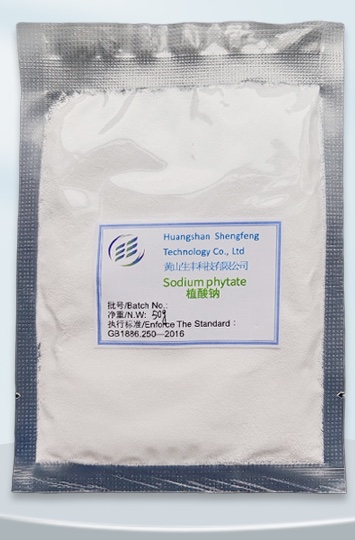
PRODUCT OVERVIEW
Sodium phytate is the sodium salt of phytic acid and can chelate metal ions. Each application requires a separate review of the formulation, process and regulatory scope.
For food use, this page only presents antioxidant applications permitted in China under GB 2760-2024. Other-market regulations, formulation levels and compatibility require technical review.
| CAS | 14306-25-3 |
|---|---|
| Molecular formula | C₆H₆Na₁₂O₂₄P₆ |
| Appearance | Crystalline powder |
| Sodium phytate content, w/% | ≥75 |
| Inorganic phosphorus, w/% | ≤0.02 |
| Chloride, w/% | ≤0.01 |
| Sulfate, w/% | ≤0.01 |
| Calcium salts, w/% | ≤0.01 |
| Lead (Pb) | ≤1.0 mg/kg |
| Total arsenic (as As) | ≤1.0 mg/kg |
| pH | 10–12 |
| Standard shown in public materials | GB 1886.250-2016 |
| Packaging | 1 kg; 5 kg; 25 kg |
| MOQ | 1 kg |
| Standard lead time | Within 3 days; confirmed for the actual order |
| Port of shipment | Shanghai |
| Storage | Store protected from light and kept dry |
| Shelf life | 12 months |
| Documents | COA and MSDS available in Chinese and English; TDS and other inspection documents provided for the actual product |
APPLICATION REVIEW
Evaluation as a chelating agent. Share the complete formula, other ingredients and process conditions for a compatibility and addition-level review.
Evaluation for metal-ion control, metal surface treatment and other industrial processes based on actual operating conditions.
Only antioxidant uses in categories permitted under GB 2760, with the corresponding limits. Unlisted categories are not recommended.
Based on GB 2760-2024 Table A.1. Phytic acid and sodium phytate are classified as antioxidants. Check the current standard, food category and product requirements before use.
| Food category code | Food category | Maximum use level |
|---|---|---|
| 02.01 | Fats and oils essentially free of water | 0.2 g/kg calculated as phytic acid |
| 04.01.02 | Processed fruit | 0.2 g/kg calculated as phytic acid |
| 04.02.02 | Processed vegetables, excluding frozen vegetables and fermented vegetable products | 0.2 g/kg calculated as phytic acid |
| 05.04 | Decorated candies, non-fruit toppings and sweet sauces | 0.2 g/kg calculated as phytic acid |
| 08.02.02 | Cured meat products | 0.2 g/kg calculated as phytic acid |
| 08.03.01 | Sauce-braised meat products | 0.2 g/kg calculated as phytic acid |
| 08.03.02 | Smoked, roasted and grilled meat products | 0.2 g/kg calculated as phytic acid |
| 08.03.03 | Fried meat products | 0.2 g/kg calculated as phytic acid |
| 08.03.04 | Western-style ham products | 0.2 g/kg calculated as phytic acid |
| 08.03.05 | Sausage products | 0.2 g/kg calculated as phytic acid |
| 08.03.06 | Fermented meat products | 0.2 g/kg calculated as phytic acid |
| 09.01 | Fresh aquatic products, shrimp only | Use as needed for production; residue ≤20 mg/kg |
| 11.05 | Flavored syrups | 0.2 g/kg calculated as phytic acid |
| 14.02.03 | Fruit and vegetable juice beverages | 0.2 g/kg calculated as phytic acid in the ready-to-drink state; solid beverages adjusted by dilution |
Use is not recommended in fermented vegetable products, frozen vegetables, soybean products or food categories not listed above. For food regulations outside China, please contact our sales and technical teams.
Share the product, application, quantity and destination. Our team will confirm specifications, packaging and documents.